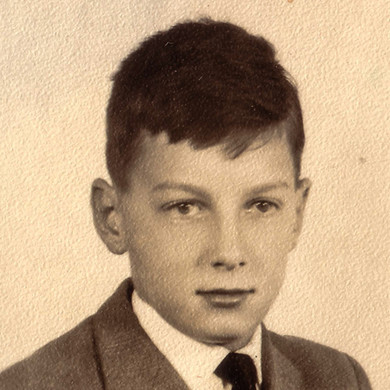
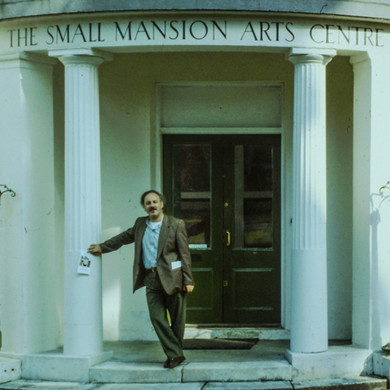
Renato Zanette was born on 16 August 1951 in Longobucco, in Calabria, to a family from Osigo, a small hamlet in the municipality of Fregona, in the province of Treviso.
At the age of nine he was sent with his brothers to a boarding school in Pescia, in Tuscany, where he stayed for several years.
The first record of him as a painter dates from 1964, when, at just thirteen, his work was singled out at a competition and he was invited to exhibit at the Centro Artistico Internazionale in Varese. None of these earliest works has come down to us.
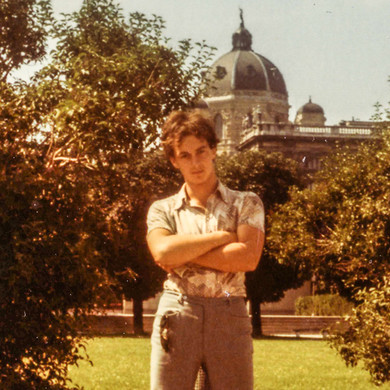
After secondary school he enrolled in Agricultural Sciences at the University of Padua. It was in these years that he began to engage actively with art, frequenting the various galleries of the city.
He also began to spend time among other artists, and in particular attached himself to a group at the Forte Col Vaccher in Tai di Cadore, which had become a meeting place for art lovers from many parts of Italy. It was there that he found the contacts for his first solo exhibition, held at Mendoza Arte in Belluno in 1973. That same year he showed his work at the Caffè Nuova Unione in Vittorio Veneto and won third prize at the “Festa del Colore in Contrada Granda” in Conegliano.
Over these years his work moved from an early figurative period (glimpses of Venice, first studies of the human figure, a series of women’s faces) towards what would prove the turning point in his formation as an artist: metaphysical painting. It was these works that left the deepest mark on everything he painted afterwards, through all his later changes of style.
In the same period he began the relationship with Patrizia, who would become his wife, and to whom he dedicated several portraits.
His standing within his circle of friends grew, and Renato often gave his paintings away, or exchanged them with other local artists.
These were very prolific years, and he seems to have allowed himself more time for what he loved. He began to paint on canvas as well, after the first works, made mostly on sheets of plywood or “on whatever was to hand”, often using both sides of any surface he came across.
Within a few years he had already experimented with several idioms and acquired an increasingly assured technique.
1974 was a genuinely interesting year: at only twenty-three he made one of his most important works, the Orchestra Leader.
That same year saw the first work inspired by the Art Informel of Alberto Burri, in which he glued pieces of potato sacking to the canvas. This was his first move towards matter painting.
Meanwhile Renato decided to leave university, although only a few examinations stood between him and his degree. After a year of military service, which he left in order to finish as a civilian conscript, he began teaching the subjects he had studied in Padua at a vocational school.
In 1975 he held a solo exhibition at the Hotel Winkler in Vittorio Veneto, and the following year was invited to take part in the III Concorso Nazionale di Pittura at Montereale Valcellina, in the province of Pordenone. He also joined the Veneto-Lazio painting meeting at Feltre for two consecutive years.
In 1976 he was included in the encyclopedia “Arte Italiana nel XX Secolo”, published by Edizioni Due Torri of Bologna.
A quieter period followed, between the end of the 1970s and the early 1980s, in which his output fell without ever stopping altogether.
He married in 1980 and painted a fresco reproducing Leonardo da Vinci’s celebrated Battle of Anghiari, a lost work which he reconstructed from Rubens’ copy. Two years later his first child, Ilaria, was born.
In the mid-1980s new materials entered his work: pieces made on sheet metal, in which he used the rust itself as an element of the picture.
In 1986 he took part in the X Concorso Nazionale di Pittura at Bussolengo, in the province of Verona.
In 1987 he held a solo retrospective entitled “20 anni di pittura” at the middle school in Fregona, organised with the Pro Loco as part of the Torchiato festival. Two months later his second child, Alessandro, was born.
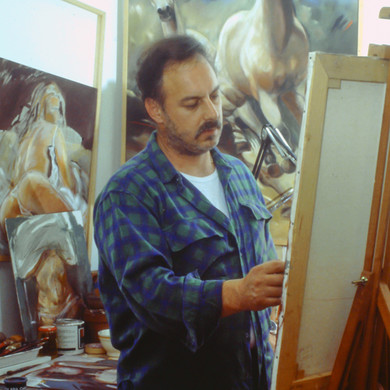
His way of painting changed in these years too, becoming more dynamic and more colourful, and bringing him to the attention of a wider public. In 1989 he produced what is perhaps his most ambitious work, the Art-Time series, six panels in sequence on plywood.
Several exhibitions followed in the provinces of Treviso and Pordenone. He was also invited to teach courses at the Gruppo Ricerca Pittorica in Cappella Maggiore.
It was in this period that he came into contact with new artists from the north-east, and began to exhibit with some of them outside Italy as well: in 1990 he was in Germany, first at Olpe and then at Marburg; the following year at Millstatt in Austria. In 1992 some of his works were shown in the United States at Rhodes College in Memphis, through his collaboration with the art critic and friend Ted Higgs. That same year he also exhibited twelve works from his most recent output in London.
In the years that followed he went on making highly animated paintings, returning to subjects he had used before, such as jockeys and butterflies. In this phase he preferred acrylics on canvas for the speed with which they dry on the surface, so much so that he could sometimes finish a work extremely quickly, in a matter of minutes.
In 1995 he was commissioned to design the logo of the IPSAA, the agricultural vocational school where he taught, and chose a symbol representing the sun, the earth and wheat.
His last work too, a still life, was a commission. Left unfinished, it shows the fruit of that autumn, which was his last.
He died suddenly in hospital in Treviso, of an aortic aneurysm, on 27 October 1996.
Renato Zanette was a self-taught painter. Throughout his life as an artist he had many influences, or admirations, which is perhaps the better word. Almost all of them were Italian, the exception being the Englishman Francis Bacon. Beginning with the old masters, Leonardo, Michelangelo and Caravaggio, passing through the artists of the last century, De Chirico, Afro and Burri, Renato also looked closely at what was being made around him, at Luigi Voltolina and at other artists he had the chance to exhibit alongside and exchange ideas with.
For all that, a personal way of approaching art, and of setting down his own feelings in paint, is present throughout his work.